

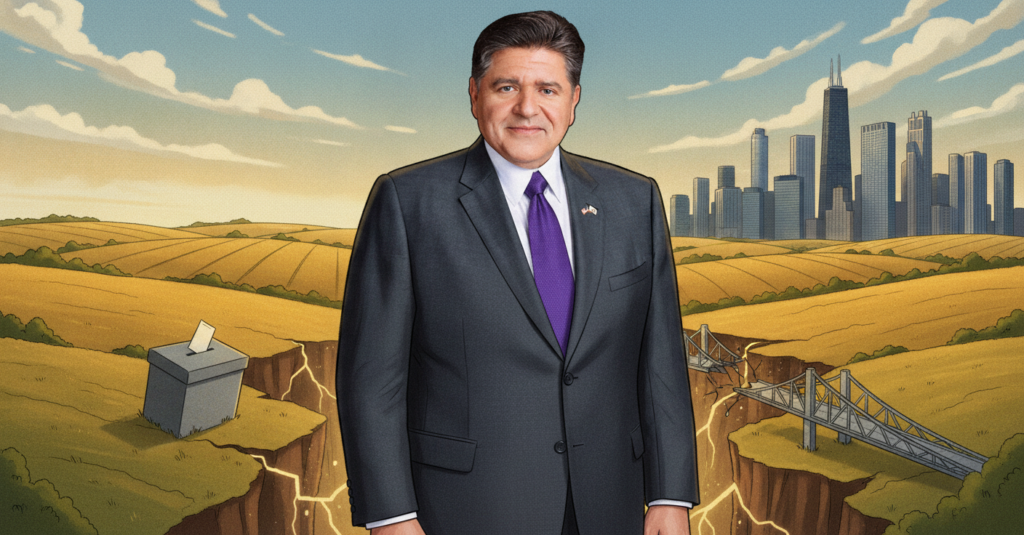
Voters across rural and downstate Illinois will encounter a provocative ballot question in the November 3 general election: whether their local county boards should explore splitting away from Cook County to establish a separate U.S. state. The nonbinding initiative, coordinated by the advocacy organization Illinois Separation led by director Loret Newlin, reflects a deepening political divide between the Chicago metropolitan area and the rest of the state.
Identified on election listings from BallotReady as the nonbinding “STATE SPLIT (Illinois Separation Referendum),” the measure does not create an immediate 51st state or unilaterally redraw state boundaries. Instead, the language asks county officials to begin formal communication with other non-Cook County jurisdictions to discuss the viability of separating from Cook County and seeking admission into the Union, subject to subsequent voter approval.

Downstate Discontent Over Cook County Dominance
Supporters of the initiative contend that the concentration of Illinois’ population in Cook County gives Chicago lawmakers a disproportionate grip over state government. Organizers assert that metropolitan legislators dominate state policy decisions concerning taxes, firearms, energy, public education, criminal justice reform, and business regulations, leaving rural populations politically sidelined.
According to representatives from Illinois Separation, the ballot campaign aims to push for governance that better mirrors the priorities of downstate families, agricultural producers, small business owners, and gun rights advocates. While the measure cannot alter state borders on election night, organizers view the vote as an official mechanism for communities to record their frustration with the state’s traditional political power center.
Counties and Townships Weighing the Split
The push appears on ballots across at least 11 counties and several individual townships, with some reports tallying as many as a dozen counties participating in this cycle. Local jurisdictions named in coverage include Coles, Gallatin, Hamilton, Henderson, Macoupin, McDonough, Monroe, Piatt, Saline, Warren, and Washington counties.
Should the U.S. Strengthen Border Security?
Click to cast your vote
The upcoming referendums build on previous regional efforts. According to organizers, 33 Illinois counties have already adopted comparable nonbinding measures in past election cycles, reportedly generating an average approval rate of approximately 74 percent. This established track record indicates that rural discontent with Cook County governance has steadily grown into a persistent statewide movement rather than an isolated political protest.
Do You Still Have Trump’s Back 100%?
Click to cast your vote

Has Ilhan Omar DESTROYED Minnesota?
Click to cast your vote
Steep Constitutional Hurdles
Despite the support recorded in earlier county votes, the legal pathway to actual statehood faces formidable constitutional barriers. Newlin has acknowledged that the referendums are designed to initiate a conversation rather than finalize a partition.
Under Article IV of the U.S. Constitution, creating a new state from an existing one requires the formal consent of both the state legislature and the U.S. Congress. In practical terms, advocates would need approval from Springfield—where Governor J.B. Pritzker and legislative Democratic majorities currently hold power—as well as federal lawmakers in Washington. Even if voters deliver sweeping approval in the participating counties, securing legislative consent from Springfield remains an immense obstacle.
While skeptics point to these constitutional barriers as evidence that statehood is improbable, advocates emphasize that the referendums provide non-metropolitan voters with a clear platform to demonstrate the depth of their political alienation.

0 Comments