

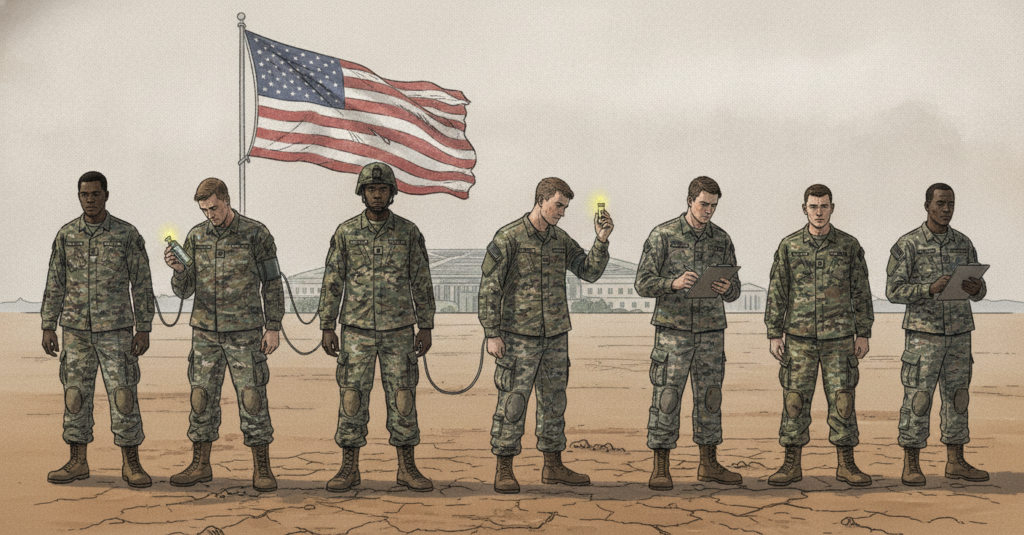
The Department of Defense has initiated new testosterone-deficiency screening guidelines for male service members aged 30 and older, responding to what federal health and defense leaders describe as a mounting threat to armed forces readiness. The policy coincides with stark assessments of the civilian recruitment pool, where more than 70 percent of young American men are now ineligible to serve without a waiver.
According to federal health officials, the confluence of physical health problems, chronic disease, mental-health struggles, and substance use has substantially restricted the number of qualified applicants nationwide. The military’s new health initiatives indicate that concerns over physical capacity and hormonal decline have expanded from incoming recruits to active-duty personnel already serving in uniform.

Targeted Screenings and Active-Duty Health Guidance
Details reported by FOX 11 Los Angeles indicate that the Defense Department’s new protocol for male personnel begins with an evaluation of clinical symptoms and established risk factors. When medically warranted, service members can access diagnostic blood testing and subsequent treatment. Defense guidelines do not mandate testosterone therapy for any service personnel; interventions remain strictly clinical decisions made on an individual basis.
Adm. Brian Christine, a senior official at the Department of Health and Human Services and an experienced urologist, explained that hormonal deficiencies carry direct consequences for operational effectiveness. Adequate hormone health remains integral to sustaining physical endurance, regulating mood, supporting energy reserves, and preserving the overall stamina required for military duties. Christine noted that population-level testosterone measurements among American men have experienced a pronounced downward trajectory across several decades, though the comprehensive scientific causes remain under investigation.
National Institutes of Health Director Jay Bhattacharya separately told Fox that medical researchers must conduct further study to pinpoint the exact mechanisms accelerating this generational decrease before standardized broad guidance can be established. Meanwhile, the administration is also formulating targeted hormonal-health recommendations tailored to female service members, consulting directly with specialists in women’s health.

Should the U.S. Strengthen Border Security?
Click to cast your vote
Recruitment Shortfalls and Congressional Scrutiny
The operational challenge extends well beyond the active-duty ranks. Data compiled in a congressional defense report published by GovInfo revealed that nearly 77 percent of Americans between the ages of 17 and 24 cannot satisfy accession standards without an approved waiver. The figure reflects the general population rather than applicant rejection rates, meaning defense analysts estimate that merely 23 percent of the demographic meets baseline qualification benchmarks outright.

Do You Still Have Trump’s Back 100%?
Click to cast your vote

Has Ilhan Omar DESTROYED Minnesota?
Click to cast your vote
A broad spectrum of issues limits entry into the armed forces, including weight standards, chronic medical diagnoses, mental-health conditions, educational shortcomings, aptitude scores, legal histories, and past drug use. Compounding the physical constraints, Adm. Christine highlighted that only an estimated 3 percent of eligible young Americans currently express a desire to join the armed services, forcing military recruiters to compete for a very narrow fraction of the population.
In response to growing reliance on medical and conduct exemptions, Congress has directed the Pentagon to examine the long-term outcomes of recruits admitted via waivers and specialized physical preparatory programs. Lawmakers are investigating whether these alternative entry paths successfully cultivate resilient, career-ready personnel or inadvertently push medical vulnerabilities and early-separation liabilities deeper into the military structure.
Researching Environmental and Metabolic Causes
Medical experts emphasize that hormonal shifts in the general public represent a complex public health challenge rather than an isolated cause for recruitment troubles. An open-access review archived in 2026 by the National Library of Medicine examined sustained declines in male testosterone levels and sperm counts internationally, highlighting a multi-factorial landscape of potential contributors.
Researchers identified multiple overlapping environmental and behavioral influences, including escalating obesity rates, sedentary lifestyles, tobacco use, industrial air pollution, exposure to heavy metals, and contact with endocrine-disrupting chemicals. The study cautioned that because these environmental and lifestyle factors frequently intersect, establishing definitive direct causation remains challenging.
Medical professionals also caution that broader demographic trends do not equate to individual clinical diagnoses. A single low laboratory reading does not automatically justify medical treatment. Proper endocrinological practice requires identifying persistent symptoms in tandem with consistently depressed laboratory metrics, particularly given that improper hormone administration introduces separate medical hazards, including disruptions to natural fertility.
Strategic Priorities and Readiness Standards
The Department of Defense relies on recurring annual physical examinations and branch-specific medical baselines to determine if personnel remain qualified for deployment and operational duties. According to the Military Health System, accession and medical retention standards are managed individually, allowing specific medical cases to receive waivers while requiring higher-tier administrative reviews for more severe health conditions.
Incorporating testosterone assessments into existing evaluation systems provides a pathway to detect symptomatic hormone depletion before it degrades operational performance or prompts medical discharge. The approach aligns with strategic directives championed by President Donald Trump and Defense Secretary Pete Hegseth, who have both emphasized physical conditioning, lethality, recruiting rigor, and a military culture oriented around core combat capabilities.
Defense leaders maintain that preserving these strategic goals hinges on confronting the foundational health challenges of the civilian population from which the armed forces draw. By introducing systematic screenings for service members aged 30 and older, defense officials are formally treating hormonal and metabolic wellness as a structural element of national defense readiness.

0 Comments