

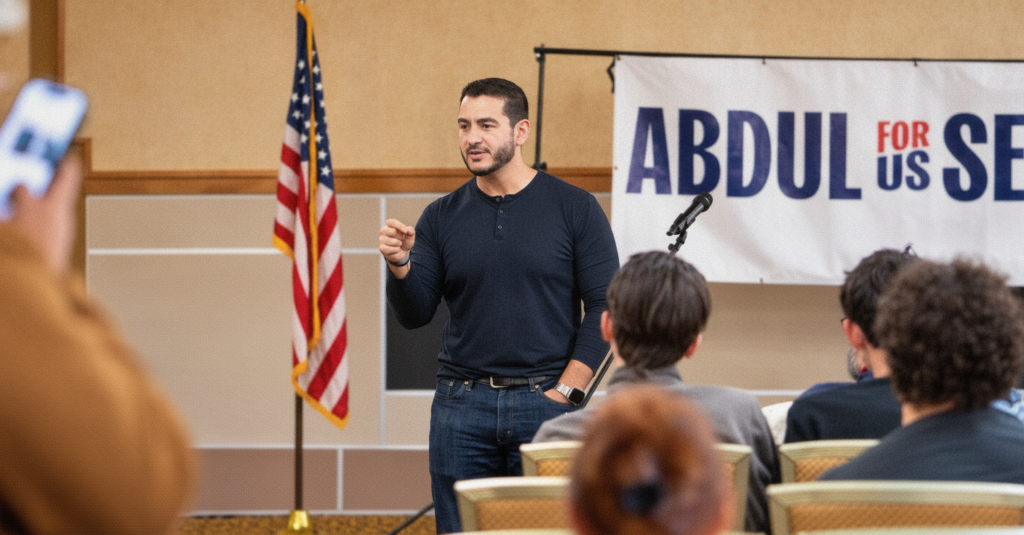
Michigan Democrat Abdulrahman Mohamed El-Sayed secured a seat in the United States Senate on Tuesday night, becoming the first Muslim ever elected to the chamber. Addressing a cheering crowd of supporters in Detroit, the senator-elect marked the historic milestone by introducing himself by his full name and incorporating Arabic phrases into his victory remarks before delivering sharp criticism of foreign military spending.
During his address, El-Sayed reflected on his campaign journey, noting that he had frequently replied with inshallah—an Arabic expression meaning “God willing”—whenever supporters asked about the election’s outcome. With the contest decided, he told the gathering that the phrase could now shift to alhamdulillah, which translates to “praise be to God.”

Domestic Priorities and Criticism of Foreign Conflict
Following the celebratory opening, El-Sayed transitioned into the progressive policy arguments that featured prominently throughout his campaign. He asserted that American citizens want their tax dollars directed domestically into schools, healthcare systems, and infrastructure projects rather than overseas conflicts.
In remarks widely interpreted as a critique of United States foreign policy and its backing of Israel, El-Sayed declared that taxpayers do not want their resources spent on “apartheid,” “genocide,” or “war.” He further argued that American funds should not be used to finance bombs dropped on children abroad. While he did not explicitly name Israel in that portion of the speech, observers and media outlets noted that the phrasing reflected the sharp foreign-policy critiques that have characterized his platform.
According to reporting from The Times of Israel, El-Sayed’s campaign rhetoric had previously drawn scrutiny from Jewish voters, particularly regarding his past response to an attempted terrorist attack on a Michigan synagogue and preschool, an incident for which he subsequently issued an apology. His victory address reiterated themes linking domestic budget investments to objections over foreign military involvement.
Should the U.S. Strengthen Border Security?
Click to cast your vote
The Path to the Senate Victory
El-Sayed, a physician and former health director for the city of Detroit, captured the open seat left vacant by retiring Democratic Sen. Gary Peters. His general-election victory followed a contentious and high-cost Democratic primary race in which he defeated U.S. Rep. Haley Stevens.

Do You Still Have Trump’s Back 100%?
Click to cast your vote

Has Ilhan Omar DESTROYED Minnesota?
Click to cast your vote
In the general election, El-Sayed faced Republican nominee Mike Rogers, a former congressman and FBI agent who ran with the endorsement of Donald Trump. The Associated Press officially projected El-Sayed as the winner early Wednesday morning, a call reported by Local 4 Detroit shortly after 2:28 a.m. Eastern time. At the time of the projection, unofficial returns with roughly 71 percent of precincts reporting placed El-Sayed at approximately 52 percent of the vote compared to 46 percent for Rogers, alongside minor-party candidates.
Subsequent ballot updates confirmed the margin, keeping the seat securely in Democratic control while elevating a prominent progressive figure to national office.
Reactions and Political Implications
The election outcome represents a notable triumph for the progressive wing of the Democratic Party, strengthening a national movement closely tied to leaders such as Sen. Bernie Sanders and Rep. Alexandria Ocasio-Cortez. Following the projection, El-Sayed addressed his constituents in a statement published online.
“It is my honor and privilege to be headed to the US Senate to serve the great state of Michigan,” El-Sayed wrote. “Michigan, we did what they said couldn’t be done. We won. Together. Now the real work begins.”
While supporters celebrated both the demographic breakthrough and the progressive policy agenda El-Sayed ran on, his victory speech also generated polarized reactions on social media. Video clips of his Arabic remarks and his rhetoric regarding foreign war funding circulated widely, drawing praise from left-wing advocates and strong pushback from political critics who expressed concern over his foreign policy stance and ideological direction as he prepares to take office.

0 Comments